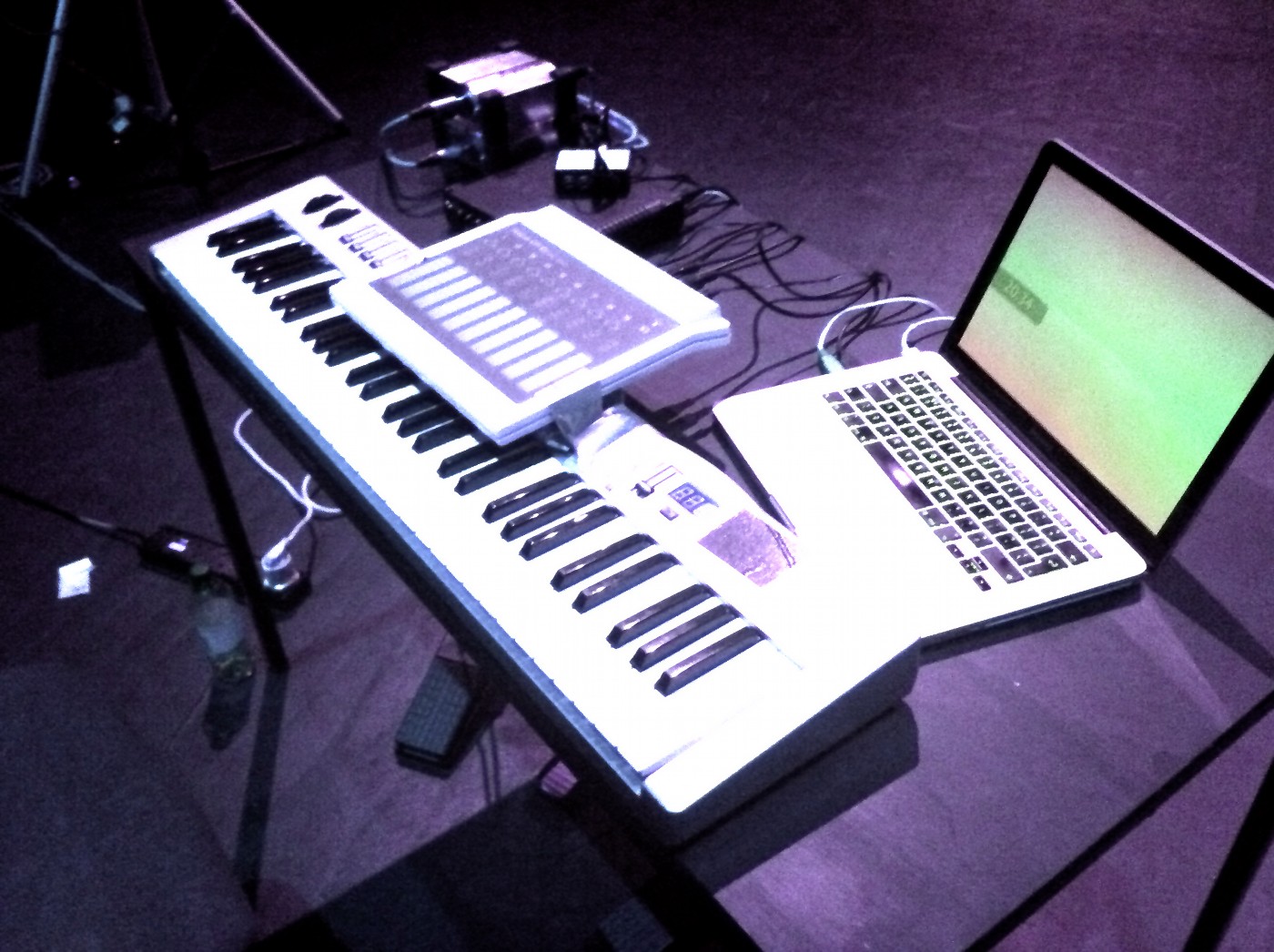
Like I said last time, necessity is the mother of invention. Two things sparked this second duo*3 event at DSMC: Gerald Cleaver was going to be available (been trying to corner him with a gig since January), and Viv Corringham had just moved to New York. I then asked Chris Pitsiokos if he’d like to contribute a set after Anna Webber had to drop out (as much as I enjoyed Chris and Philip White’s set, and I wouldn’t substitute it for anything else, would loved to have heard what Anna might have brought to the table—next time). And like the last duo*3 event, because of the performers, the results were unimaginably better than the minimal curatorial hand I played.
So big, big thanks to all the performers at the August 13 event: to Chris and Philip White for their sense of play (and for consistently hitting the resonance frequency of the DSMC buzzer); to Viv and Andrea Parkins for a performance full of humor, and a kind of cargo-cult elegance; and to Gerald for his limitless imagination, for the 45 minute creative, musical and physical workout, and for making the set sound just that much better. And kudos again to Don Mount for the indefatigable work as video documentarist [watch/listen…].
Music by Han-earl Park, Catherine Sikora and Josh Sinton.
Recorded live, March 26, 2013 at Freddy’s Bar, Brooklyn.
Performance presented as part of On The Way Out curated by Michael Evans and Anders Nilsson.
Recorded by Don Mount.
Mark Trayle (electronics), Gascia Ouzounian (violin), Chris Brown (piano), Paul Stapleton (percussion), Dan Goren (trumpet), Don Nichols (percussion), Simon Rose (saxophone), Gustavo Aguilar (percussion), Han-earl Park (guitar), Ulrich Mitzlaff (’cello), Tasos Stamou (zither), Dominic Lash (double bass), Christopher Williams (double bass), Nuno Rebelo (guitar), Richard Scott (synthesizer), Steven Davis (drums), Pedro Rebelo (piano), Justin Yang (saxophone) and Franziska Schroeder (saxophones).
Thanks to everyone who contributed to the noise at the July 26 event. I was bowled over by the awesome time-and-motion-studies of Patricia Franceschy and Kate Gentile (Kate’s composition, in particular, was a highlight). I take my hat off to Swim This (Nick Didkovsky, Gerry Hemingway and Michael Lytle) for their playfully raucous set, and for inviting me to join them on stage. Thanks again to Don Mount for the videography. Last but not least, thanks to all who came to witness the noisy bodies in motion!
I don’t expect my approach to real-time, interactive play and improvisative noise overlaps much with Richard Pinnell’s tastes, but Pinnell takes time to write a short overview of some of my download releases in the July issue of The Wire:
Four ‘name your price’ downloads from… guitarist Han-earl Park in various improv formations situated at the more traditional, loquaciously active end of the spectrum…. The sense of energy and joy in Park’s playing spills over into this flurry of online activity… fans of the talkative brand of improvised music will find something of value.
Traditional? Talkative? Vague? Relentless? Claustrophobic? What do you think?
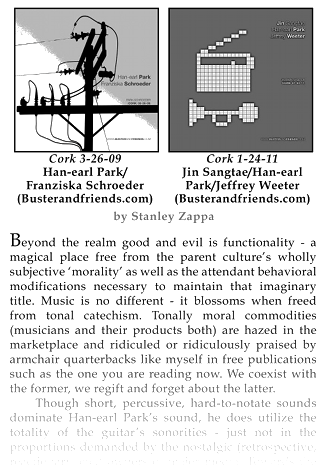
Though short, percussive, hard-to-notate sounds dominate Han-earl Park’s sound, he does utilize the totality of the guitar’s sonorities—just not in the proportions demanded by the nostalgic (retrospective, reactionary, etc.) owners of major media. Towards the end of “Nova” on Cork 3-26-09, Park even plays chords with voices that lead. Franziska Schroeder’s… saxophone is an excellent counterpoint to Park’s electric guitar, mostly because her post-tonal sensibilities are conceived and executed so well. Very simply, contemporary improvisation has grown beyond the 12-note chromatic division of the octave. Buh bye! It is this extended tonal consciousness by which Schroeder achieves the elusive by keeping the narrative aspects to a minimum without regressing to that childish, abnegating HVAC morality holding hostage the imagination of so many wind and reed players in our improvising community. [Read the rest…]
Meanwhile, citing the recording as an “equally, if not more convincing, aspect of Park’s musicality,” Zappa describes the ensemble with Jin Sangtae and Jeffrey Weeter as a context of:
…Minimal tonal or harmonic sticking points to derail the listening experience—an experience not to be missed by Park agnostics and believers alike. Jeffrey Weeter on percussion and Jin Sangtae on what are most likely hard drives in varying states of repair… could very well be the perfect counterpoint to Park’s active, strident departure from the last 100 years of the prevailing guitar morality.
Sangtae’s post-human sonic contribution makes Park’s departure seem less heretical…. Here is unanimity of method and likeness of function. Motility of gesture and dynamics of phrase are celebrated with sound, neither antiquated harmonic stricture nor pre-Civil-Rights-era tropes. There is a directness, a paucity of fluff, which, more than any other quality or attribute, is what separates jazz from music that emerged from and ultimately supplanted it as the ‘art music’ of our day. Sangtae deserves special mention for his vision (as does Park for including scripting him in to the group). While likely not the first to use the staccato grrrr of a hard drive for musical gesture, none have used it with as much imagination or in a setting as sympathetic as Cork 1-24-11. Sangtae’s contribution underscores the collective nature of improvisation and creates a feeling of want, where and when he is not present. Without question, Cork 1-24-11 is a conceptual and aural high-water mark few will ever reach. [Read the rest…]
Belated set of thanks for the performances earlier this month (June 5th and 9th). The biggest thanks to Nick Didkovsky and Catherine Sikora who made this Eris 136199’s stragest performance so far, with unexpected and unpredictable turns and juxtapositions; and big thanks to Michael Lytle who invited me to join him for a duo performance at ABC No Rio. Thanks also to Blaise Siwula for organizing and curating COMA: Citizens Ontological Music Agenda, and to the other musicians who shared the bill and both events. In particular, kudos to Ras Moshe, Shayna Dulberger and John Pietaro for stepping up and contributing a fantastic set (plus John said one of the nicest things about my playing after Eris’ set: “You’re the Rashied Ali of the group!”); and to Craig Flanagin and Frank Marino for their great vibe on and off stage. Special thanks to Scott Friedlander for his indefatigable and expert documentation—audio, video and photographic—and a hat tip to Don Mount for helping Eris come up with a title for our first improvisation. Last but not least, thanks to all who came to listen and witness the noise, complexity and play.
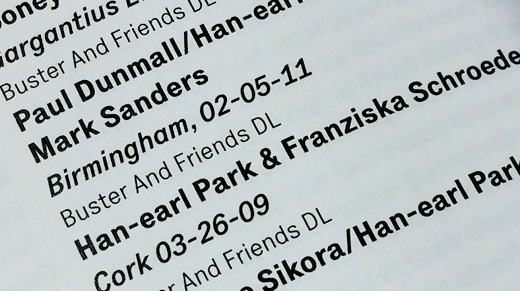
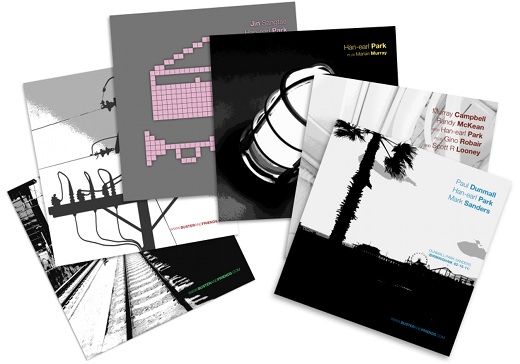
With the release of the recording with Paul Dunmall and Mark Sanders, I’ve completed the current series of download albums, and I’ve been taking a break from releasing new recordings. The albums so far—all Creative Commons licensed, and free or ‘name your price’—are collated here and on the downloads page. With a break in the release schedule, I’ve taken the opportunity to overhaul the downloads page; the most significant update since I started, in September 2010, formally offering complete concert recordings online.
One notable update to the downloads page is the addition of the recommended Bandcamp albums that accompanied the current series. As I wrote previously, there are some very fine and inspiring creative, improvised and experimental music on Bandcamp, but it isn’t always easy to find the recordings. Here’s my small contribution to help people get started. Enjoy, download, share—support creative musicians!
Two non-stop sets of improvised music. This live recording juxtaposes the formidable creativity and muscular technique of veteran improviser-saxophonist Paul Dunmall, the imaginative cyborgian virtuosity of guitarist Han-earl Park, and the ever inventive playing of Mark Sanders, arguably the most sought-after improviser-drummer of his generation. [More info…]
Murray Campbell, Randy McKean, Han-earl Park, Gino Robair and Scott R. Looney
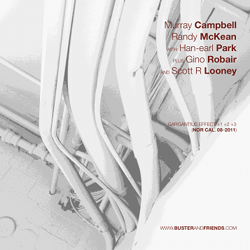
The Gargantius Effect is the brainchild of Murray Campbell and Randy McKean. This album documents Gargantius Effect’s August 2011 tour of Northern California with special guest and fellow Sonologist Han-earl Park, plus Bay Area veteran improviser, composer and electronic artist Gino Robair, and hyperpianist Scott R. Looney. [More info…]
A solo performance by guitarist-constructor Han-earl Park exploring, with feedback and resonant buzzes, the complex, cavernous acoustics of the Lewis Glucksman Gallery, and the interactions between artifact (guitar) and the body (guitarist). For ‘Strokes and Screwballs,’ Park is joined by violinist-improviser Marian Murray for a conversational improvisation. [More info…]
A stark, real-time evolution of on-stage relations. The performance took place during Seoul-based experimental electronic musician Jin Sangtae’s European tour. Featuring clanking hard drives, buzzing electronics, noisy guitars and machine gun percussion, this recording captures Jin’s meeting with guitarist-improviser Han-earl Park, and composer, drummer and intermedia artist Jeffrey Weeter. [More info plus the 24-bit edition…]
“Sounds reverberate and carry in unexpected ways, and music improvised here [The Glucksman Gallery] runs the risk of losing all definition. That [Han-earl] Park and his co-improviser Franziska Schroeder gracefully avoided this testifies to their alertness, sensitivity and experience working together in other spaces…. Indeed the evening had the feeling of conversation, with the instrumentalists demonstrating the improvisatory give-and-take of a convivial exchange of ideas.” [More info…]
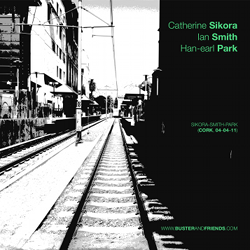
A performance by Catherine Sikora, a saxophonist with a striking, compelling sound. She has been described as “a free-blowing player’s player with a spectacular harmonic imagination and an evolved understanding of the tonal palette of the saxophone”. Sikora was joined by cofounder of the London Improvisers’ Orchestra, trumpeter Ian Smith, and guitarist Han-earl Park. Smith and Park had just come off the tour as part of the power-trio Mathilde 253 (with Charles Hayward) with Wadada Leo Smith. [More info…]
Necessity is the mother of invention. Catherine Sikora initially approached me about a ‘cryptic gig’, saying that Stanley Jason Zappa would be in town. As a last minute event, with little time for organization, I proposed an evening of duos. Pragmatically, if I’d asked for larger ensembles, people would have to check the availability of a larger number of people; something that can be time consuming in this town. So I asked Ingrid Laubrock, who I’d just been talking about playing with when I saw her at Gowanus Company in April, if she’d be interested in a duo. I also asked Andrew Drury if he could put somthing together, and he got Kris Davis onboard. When the dust settled, catching my breath, I looked at the lineup of the evening, and realized what a kick-ass group of musicians we had for the event.
Thanks to all involved in the May 16 event. For the music: Ingrid, Catherine, Andrew, Stanley and Kris; and for pitching the initial idea for the event: Catherine; for the documentation: Don Mount and Kevin Reilly (what we may lack in other resources, we more than make up for in documentation 😉 ; and for the help: Kevin. Thanks for listening: all who came to witness music in real-time!
For those that don’t know, I founded Stet Lab, a space for improvised music based in Cork. I curated the Lab between 2007 and 2011, and during that time, also wrangled its online presence. In August, I will be removing some of the audio recordings of Stet Lab’s first year (prior to the November 2008 event) from its website. Read more to find out how to save your favorite recordings. [More…]